
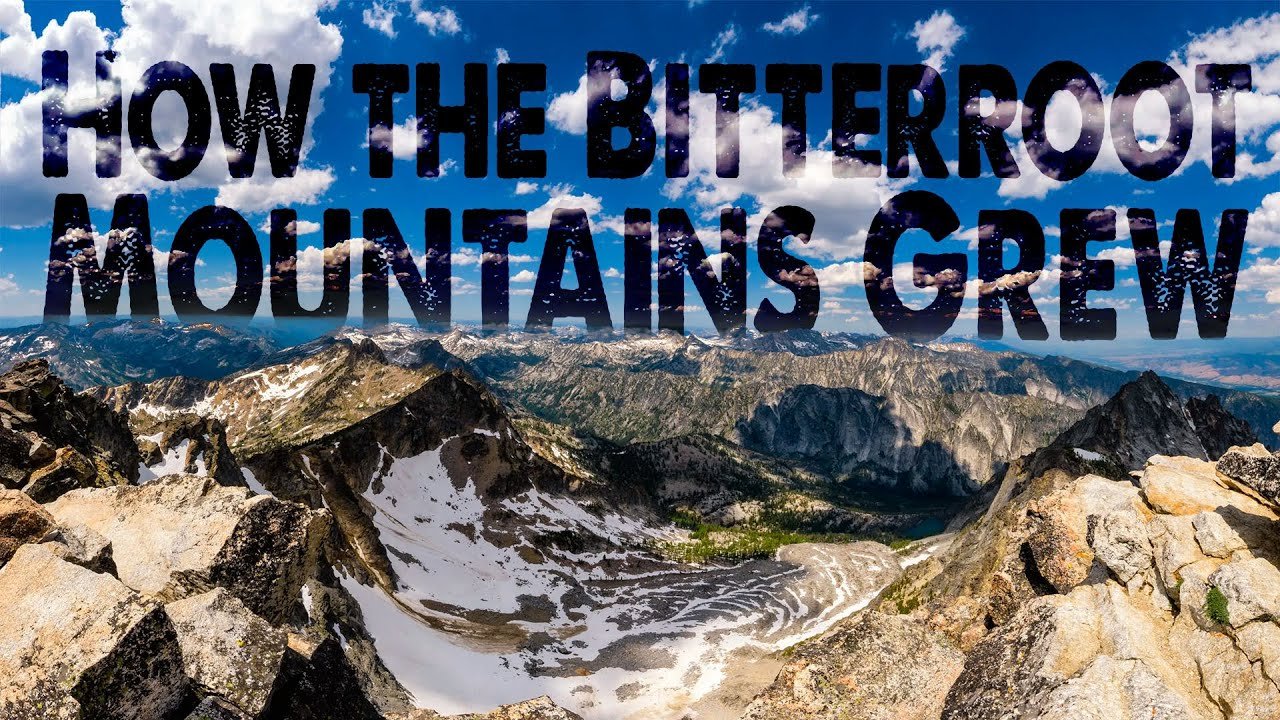
Dominating the western skyline of the Bitterroot Valley, the Bitterroot Mountains stand like a phalanx of granite, metamorphic rock, and a smattering of ancient Belt supergroup stone. Running north to south, the Bitterroot Mountains form the border of Montana and Idaho. They stand seemingly timeless, at least to the finite human perspective, but the geologic truth is that these mountains have been and are in a constant state of flux.
Pics and more at https://www.mtnmisfits.com/random-rants/how-the-bitterroot-mountains-grew-naturalist-minutes
The Bitterroot Mountains were formed through a combination of geologic forces with the first big event starting with plate tectonics. 100 million years ago, the west coast of North America was located in current western Idaho, but this was to soon change. The North American continental plate traveled west and collided with the massive oceanic Pacific plate. Being heavier, the Pacific plate pushed under the lighter North American plate. With unimaginable compression, the surface of the North American plate crinkled (like a napkin) and thickened. These “crinkles” were the proto Rocky Mountains.
As the Pacific plate dove down, it entered into the hot mantle, where the granite melted and created a large mass of magma, which rose into the rocks of the North American plate near the surface (ten miles below the surface). This process created what is known as the Idaho batholith between about 80 and 53 million years ago. Imagine giant bubble magma expanding upwards and cooling to solid rock that covers nearly10,000 square miles in central Idaho and the southern half of the Bitterroot Mountains.
With all these forces, the Earth's surface heaved, cracked, and slid around in a chaos of geology. The sedimentary Belt layer was on top of the heap, but not for long. Giant slabs of the formation slid off the east face of Bitterroot Range as a hunk of Idaho batholith moved towards the east, and thus the Sapphire Mountains of the eastern side of the Bitterroot Valley were formed in a rapid seven million years.
Now let’s add another process to mountain building or progeny of the Bitterroots – glaciers. During the great glacial period of the Pleistocene, massive glaciers sculpted the distinctive shapes of the Bitterroot Mountains and their valleys. Ice sheets flattened the valleys and mountains glaciers flowed down from the peaks and carved dramatic U-shaped profiles into side drainages that flow eastward into the Bitterroot Valley.